Print
By Pedro Bazanelli | China Daily |
Updated:
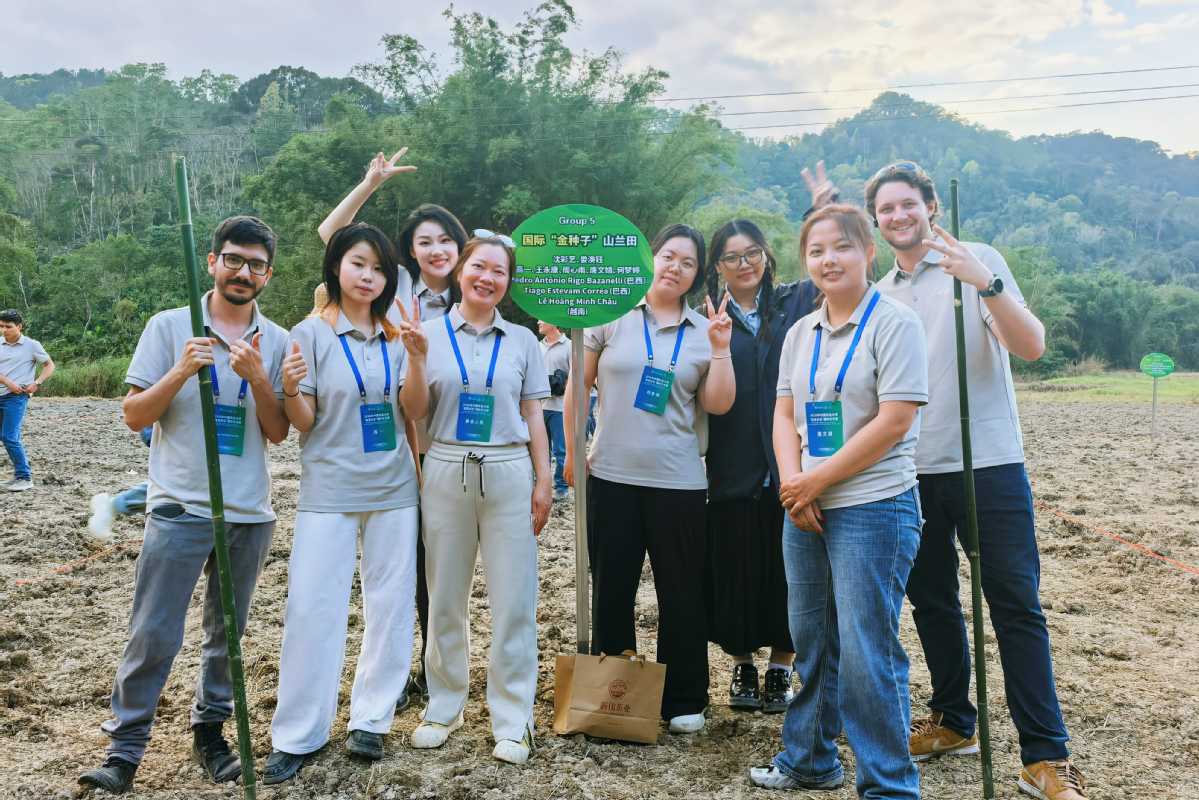
Pedro Bazanelli (first from right) experiences China’s rural revitalization during Hainan agriculture camp. [Photo provided to China Daily]
Standing in Hainan's warm tropical air, I was struck by how familiar the landscape felt. The lush greenery reminded me of home in Brazil. Yet the development model unfolding around me was something entirely new.
My journey to Hainan began several months after I arrived in China in September 2025 to study international development policies at China Agricultural University (CAU). Since then, my professors have often encouraged me to visit villages where rural revitalization is taking place, with some projects developed in partnership with the university.
That opportunity finally came in January 2026, when students from China, Brazil, Kazakhstan, Vietnam, Thailand, and the United States gathered in Hainan for the university's 2026 "Future Agriculture" Winter Camp.
The camp began with visits to several of the island's leading agricultural research institutions, including an international maize research center in Sanya and the Nanfan Silicon Valley seed-industry innovation base, followed by the Chinese Academy of Tropical Agricultural Sciences in Haikou.
There, I learned that Hainan, as a free trade port with a tropical climate, is more than a commercial hub — it is also a strategic center for seed breeding and modern agriculture. The "Nanfan" system, which means "breeding in the south", is a national strategy that uses Hainan's warm winters to accelerate crop breeding cycles, allowing up to three generations of seeds to be cultivated each year.
The Nanfan model not only strengthens China's food security but also offers an inspiring blueprint for other tropical regions with similar climatic advantages.
As an agricultural scientist from Brazil, I found myself thinking about how this strategic concentration of resources could help optimize seed development programs back home.
However, the camp also showed that rural revitalization in Hainan is not driven by technology alone. The program was designed to demonstrate the connection between scientific research and the daily lives of rural communities.
We visited Li and Miao ethnic villages in Qiongzhong and Danzhou, where we saw how technologies are adapted to the realities of local farmers. At the Shanlan Rice Cultural and Industrial Park in Qiongzhong, for example, a traditional crop has been scientifically enhanced and scaled up for industry, transforming Shanlan rice into a high-quality rice wine sold at premium prices. The project helps ensure both cultural preservation and economic sustainability for local residents.
At Sangeng village in Sanya, we learned about several social projects organized by CAU that demonstrate how academic institutions can work directly with communities. In the field of agronomy, CAU provides new and improved rice seed varieties better adapted to the region's climate and local farming systems. With the support of CAU, the village primary school also hosts lessons on organic agriculture, teaching students how to reuse food and agricultural residues and transform them into effective fertilizers through traditional fermentation techniques. These initiatives make a meaningful contribution to local public welfare.
Local cultural heritage is also remarkably well preserved. One prominent example is the Li brocade weaving technique, used to create intricately patterned garments traditionally worn during important ceremonies. Today, this craft is also being developed into artistic and cultural products that are popular among tourists. The skills are carefully passed down from older women to younger generations, ensuring the continuity of the tradition.
These initiatives not only support the development of farmers and residents but also promote rural tourism and turn cultural heritage into a source of economic growth.
Improved living conditions and broader opportunities also make rural areas more appealing to younger generations and help attract young talent.
The camp ultimately became much more than an academic trip. It provided a comprehensive view of China's approach to rural revitalization: rather than replacing traditional practices with technology, the model focuses on equipping communities with the knowledge and tools needed to strengthen their existing assets.
It made me reflect on Brazil's traditional communities — quilombolas, indigenous groups, and riverside dwellers — and how similar approaches could support their growth.
Leaving Hainan, I felt a renewed sense of possibility — that with the right mix of science, culture, and local engagement, rural revitalization can be both sustainable and empowering.
Copyright © Sanya Municipal Government. All rights reserved.
Presented by China Daily.