Print
english.sanya.gov.cn
Updated:
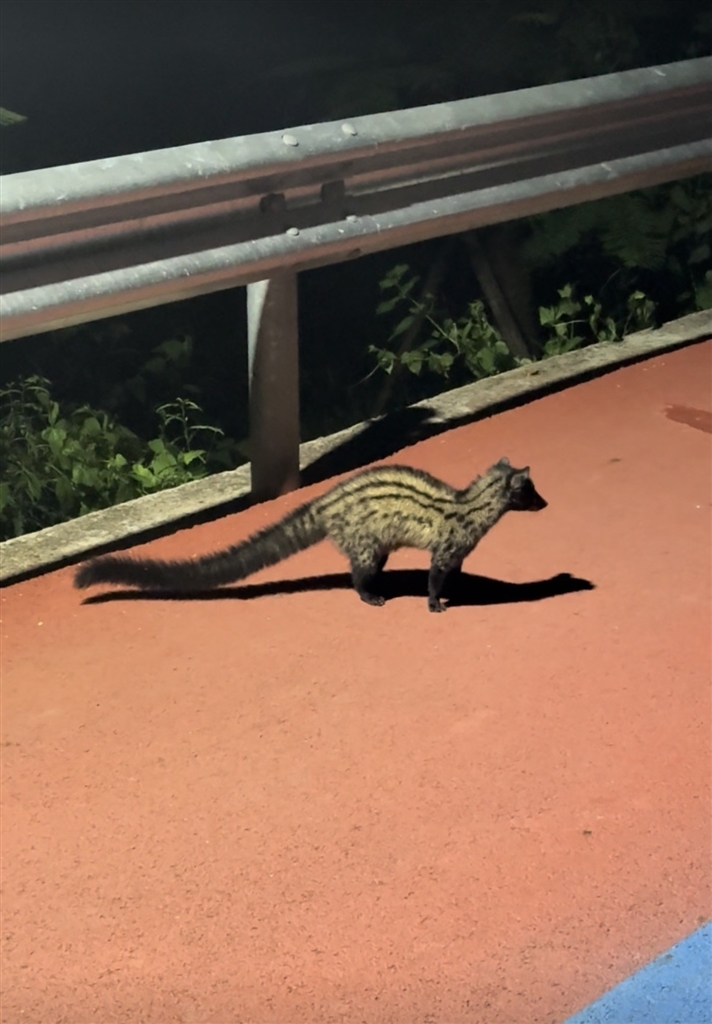
An Asian palm civet takes a leisurely walk in Sanya's Linchunling Forest Park. [Photo/Sanya Daily]
Recently a resident of Sanya, while hiking in Linchunling Forest Park, came across an Asian palm civet (Paradoxurus hermaphroditus) with three cubs.
The resident noted, "The ecology in Sanya has improved so much compared to the past. There are more monkeys in Linchunling, and now seeing an Asian palm civet suggests that the environment is nurturing both people and wildlife."
Known as the common palm civet, toddy cat or musang, this animal is a second-class nationally protected species. Hainan is its primary habitat, with sightings often reported in areas like the Changjiang Haiwei National Wetland Park.
In 2024, activity of this species was documented in Changjiang Li autonomous county, Hainan province, as well as Fengqing county and Xiaoheishan mountain in Longling county, Yunnan province.
Asian palm civets are nocturnal, solitary and naturally wary of humans, making daytime appearances rare. A mother civet out with her cubs at night is a clear sign of the ongoing improvement in urban and nearby mountain ecosystems.
Sanya's mountains are not only scenic but also home to various wildlife neighbors. The region boasts a rich diversity of terrestrial wildlife and a variety of habitats, with many protected species.
Currently, Sanya is home to 210 national and provincial protected terrestrial wildlife species, including 8 first-class nationally protected species, 68 second-class nationally protected species and 134 provincial protected species, creating a comprehensive wildlife protection framework.
Raising public awareness is crucial for effective wildlife conservation. In recent years, multiple departments in Sanya have joined forces to conduct various awareness campaigns, gradually weaving the ethos of wildlife protection into the fabric of the local community.
Copyright © Sanya Municipal Government. All rights reserved.
Presented by China Daily.